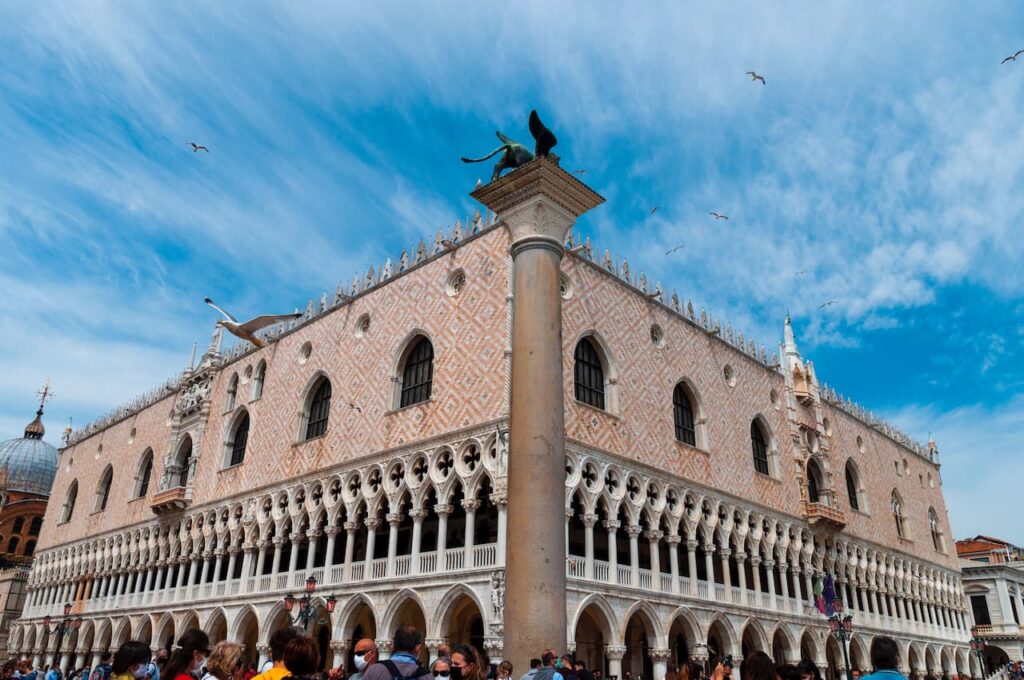
From April 30, 2025, the rooms of the Doge’s Apartment in the Doge’s Palace in Venice will host a major exhibition dedicated to a little-known but fascinating artistic period: From Painted Gold to El Greco. Venetian-Cretan Painting.
The exhibition will explore the encounter between the painting traditions of the Byzantine East and the influence of the Western Renaissance, an artistic dialogue that had its focus on the island of Crete during Venetian rule.
Doge’s Palace Venice skip-the-line ticket: quick access
Buy online. Choose your preferred time. Visit Venice’s Doge’s Palace, Bridge of Sighs, prisons and more.
You can cancel for free up to the day before your visit.
From painted gold to El Greco: a journey through Venetian-Cretan painting
- Start date: April 30, 2025
- End date: September 28, 2025
- Opening days: every day
- Location: Doge’s Palace, Piazza San Marco 1, 30124 Venice (VE)
- Price: not yet disclosed
Venetian-Cretan painting: a bridge between East and West
In the course of its maritime expansion, the Republic of Venice conquered numerous territories in the Adriatic and eastern Mediterranean, including Crete, ruled by the Venetians from 1204 to 1669. This island became a cultural meeting point between Byzantine art and Venetian pictorial language, resulting in a hybrid style known as Venetian-Cretan painting.
This artistic current is distinguished by the fusion of the Byzantine iconographic tradition, characterized by gilded backgrounds and stylized figures, and the more realistic and perspective elements typical of Western painting. Cretan artists absorbed Italian Renaissance innovations, introducing into their production greater plasticity in the figures, a wider color range, and a new sensitivity to light and space.
El Greco and the legacy of Venetian-Cretan painting.

Painting Saint Francis Receiving the Stigmata, by El Greco exhibited at the National Gallery, London, UK. Oil on canvas from the National Gallery of Ireland, Dublin. ID 290281646 © Alfredo Garcia Saz | Dreamstime.com.
Among the most celebrated painters trained in this context is Domḗnikos Theotokópoulos, better known as El Greco.
Born in Crete in 1541, El Greco began his career in the Orthodox iconographic tradition, then moved to Venice and later to Spain, where he developed his unmistakable style, characterized by elongated figures, vibrant colors, and a mystical atmosphere.
His work represents the culmination of the evolutionary path of Venetian-Cretan painting, demonstrating how the meeting of different cultures can generate extraordinary artistic innovation.
A unique opportunity at the Ducal Palace
The exhibition at the Doge’s Palace offers a journey through this extraordinary chapter in art history, displaying significant works from the Venetian-Cretan school and illustrating the transition from Byzantine painting to Renaissance art.
The rearrangement of theDoge’s Apartment will help create an immersive atmosphere, allowing visitors to understand the historical and cultural context in which this artistic current developed.
For art lovers, “From Painted Gold to El Greco ” represents an unmissable opportunity to discover a fascinating and lesser-known chapter in European artistic history, in one of Venice’s most striking settings.
Doge’s Palace Venice skip-the-line ticket: quick access
Buy online. Choose your preferred time. Visit Venice’s Doge’s Palace, Bridge of Sighs, prisons and more.
You can cancel for free up to the day before your visit.